
Swedish Cloth Instruction Guide

Mixing & soaking guideUpdated
Beequip Swedish Cloth Strips
Swedish Cloth
Oxalic Acid + Glycerine
A guide to safe mixing and soaking
Start with safety ↓
by weight
per strip
for the mixed solution
Overview
Congratulations on your decision to use Beequip Swedish Cloth Strips.
These strips are an excellent vector (carrier) for numerous different substances. A common application is to soak the strips in an Oxalic Acid / Glycerine solution. It is very important to consider one’s own safety and the safety of others who may be involved.
Before you begin
Safety comes first
Read these instructions before preparing, mixing or handling the strips.
Safety with Oxalic Acid
When handling Oxalic Acid, the minimum protective equipment required is Nitrile gloves, clothing with full length legs and sleeves and most important of all, eye protection, which should be in the form of Goggles that will protect your eyes from accidental splashes of the Oxalic Acid. A face shield is also recommended. A dust mask must be used when handling the acid in its crystal form. Any skin contact should be washed off immediately with water. Always keep a bottle of water handy. Alternatively, a water hose with a shut-off valve at the operator end is ideal and highly recommended. Refer to your Material Safety Data Sheet for emergency procedures in case of eye contact. A clean water flush is required, followed by immediate medical intervention.
Food Grade Glycerine
Glycerine is a harmless substance. However, in solution with Oxalic Acid, it may help Oxalic Acid to penetrate your skin and enter your blood stream. In excessive amounts, this is dangerous to your health. It is important to use nitrile or rubber gloves when handling Oxalic Acid / Glycerine treated strips during processing and when handling them thereafter.
Mixing the solution
The Glycerine must be heated before it mixes properly with Oxalic Acid. Only use a robust and stable heating device to heat an Oxalic Acid / Glycerine Solution. Ensure there is adequate ventilation. Containers made from Stainless Steel or Copper are the only practical containers recommended. Do not use aluminium.
Get the mix right
Cloth, ratios & specifications
Mixing Ratios
The recommended mix ratio for the Swedish cloth based on extensive experience in USA is 1:1. That means you use 50% Oxalic Acid (OA) and 50% Glycerine by weight.
NB. We recommend a 40% OA solution when soaking the Beequip cardboard strips.
Solution weight & volume
When mixed, 1 litre of 1:1 solution = 1.35kg
Or, 1 kg of solution is 0.74 litre.
Beequip Swedish Cloth Strips
Made of 70% cellulose and 30% cotton and is 100% biodegradable.
Each dry cloth strip is approx. 195mm x 43 mm x 2mm thick and weighs approx. 2.4 grams.
A strip will soak up 25 grams of OA / Glycerine solution and swell up to approx. 195mm x 47mm x 4mm thick. The Swedish Cloth does not have any colour or flame-retardant additives like some other products on the market.
Important: Research from clients in USA state that 4 strips are more effective than using a single pad with the same surface area. Having 260% more edge line, is very helpful to the efficacy.
Commercial preparation
Instructions for Bulk Mixing and Soaking
The complete 12-step process for the Beequip 74 litre tank.

Stainless Steel Jacket Heating Tank
Beequip NZ supply 304 grade stainless steel tanks with a water jacket to heat the contents. This is a very safe and efficient way to heat the solution and to control the temperature with the thermostat. This tank has 74 litre capacity and uses a 230 volt, 2kw element.
Read the safety section before mixing
Do not let the oxalic acid / glycerine solution exceed 60°C. Review the protective equipment and handling guidance.
Heat & mix the solution
-
Prepare the tank jacket
This is based on the new 74 litre tanks from Beequip NZ in 2026. Fill outer jacket of tank till you can see the water level through the filling hole. Turn on and set thermostat to 70 degrees and start heating the water in the jacket.
-
Heat the glycerine
Pour 25kg of Glycerine into the SS tank and heat to 70° C.
-
Add oxalic acid & lower the thermostat
Pour in 25 kg of oxalic acid crystals. (One 25 kg bag) The temperature will immediately drop below 40. Set thermostat to 60 degrees C and stir every 15-30 minutes till mixed. A piece of timber dressed to around 70mm x 20mm makes an excellent stirrer and lump squasher. A BBQ thermometer is also recommended, hanging from the side of the tank. Do not let the Oxalic Acid go over 60 degrees C. The chemistry in the acid starts to change.
-
Check the solution and temperature
After approx. 7 hours, the solution should be mixed and have reached the temperature close to 55°C. It will look clear, and you can clearly see the stainless-steel base of the tank. Use a BBQ thermometer to check the accuracy of the thermostat dial.
-
Alternative overnight mixing option
Alternative option. At 5pm, add the contents to the tank and set the thermostat to 56° C. At 7am, stir it every 15min. Within 1-2 hours it will be mixed.
-
Clear crystals from the outlet line
Pour 0.5 litre of solution out of the tank outlet valve into a jug. There is likely to be OA crystals sitting in the line, not properly mixed. Pour into the tank and stir. Wait 15 minutes then the solution is ready to use.
-
Fit an optional outlet elbow
The outlet valve on the 74 litre tanks have a 1.25” BSP thread. (32mm) It is beneficial to fit a 90-degree elbow for better control but not essential. Any irrigation shop will have this part.
Soak, handle & store the strips
-
Prepare 100 strips & measure the solution
Set up 100 strips in our soak bin (SKU: 751-0017) a bin with a flat base. The strips must be placed on their edge. Using a measuring jug, pour in an appropriate amount of hot solution based on 25 grams per strip. 100 strips will require 2.5kg (1.85 litres) of hot solution.
-
Keep the strips warm while soaking
Keep the bin in a warm place (30°C minimum) and the strips will soak up all the solution in approx. 30-45 minutes. The solution solidifies when it gets down to 30°C so it is important to keep it at a higher temperature for long enough to get an even soaking of the strips.
-
Use or store the strips
The strips can then be used in beehives or stored in air-tight containers or zip-lock bags.
-
Wear nitrile gloves
Use Nitrile gloves when handling the soaked strips.
-
Repeat for additional batches
If doing large batches, store the soaked strips in our Zip-Lock bags go back to step 8 and repeat the process till you have no more solution. The Below photos show this process.

100 Strips ready to soak

Solution soaked into the strips
Strips removed & put into Zip-lock Bag
Empty container ready for next batch
 ▶Close video
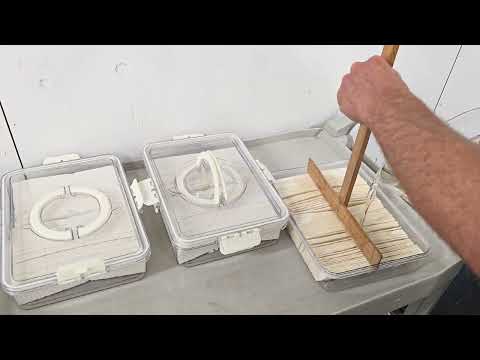
Bulk mixing video
Watch our video of this process online!
Click Here if viewing as a PDF
Watch on YouTube ↗Hobbyist preparation
Mixing and soaking in small batches
A 17-step guide to preparing 50 cloth strips with the hobbyist kit.

Hobbyist OA Kit for Swedish Cloth - 751-0045
This is recommended for soaking a small number of Swedish Cloth Strips in a safe and economical manner. Includes: -
- Small soak tub with flat base
- 4-litre pail and lid
- 1.25kg Glycerine
- 1.25kg Oxalic Acid (OA)
- 100 Beequip Swedish Cloth Strips
- 4 Ziplock Bags for soaked strips
- Digital thermometer
- Wooden trivet & stirrer
- Instruction booklet
Procedure to soak 50 Sponge Cloths
Read all safety instructions on previous pages.
Read the safety instructions ↑-
Choose a suitable pot
Locate a pot with 20cm inner diameter. (Min)
-
Heat the water
Add 10cm of water to the pot and start heating
-
Measure glycerine & oxalic acid
Add 625g of Glycerine to pail & 625g of OA.
-
Place the pail on the trivet
Add Trivet to pot and place pail on top.
-
Secure the thermometer
Secure thermometer to the side of pail.
-
Stir continuously
Stir contents continuously and watch temp.
-
Reduce the heat as water simmers
As soon as the water in the pot starts to simmer, turn to low heat.
-
Watch for a clear solution at 55°C
When the temp reaches 55°C, the solution should be mixed and will go clear.
-
Keep the solution below 60°C
Do not let the solution go above 60°C. Remove pail from the pot if necessary to stop it getting too hot.
-
Clean the thermometer probe
Remove and wash the thermometer probe in water when finished heating.
-
Arrange 50 strips on their edges
Set up 50 Swedish cloth strips in the soak bin on their edge as shown in the photo.
-
Pour the hot solution evenly
Pour the hot solution evenly over the strips.
-
Keep the strips warm while soaking
Keep the bin in a warm place (30°C minimum) and the strips will soak up all the solution in approx. 30 minutes. The solution solidifies when it gets down to 30°C so it is important to keep it at a higher temperature for long enough to get an even soaking of the strips. A fan heater blowing directly onto the bin for 30mins should give a great result.
-
Use or store the strips
The strips can then be used in beehives or stored in air-tight containers or zip-lock bags.
-
Use gloves or stainless steel tongs
Caution: Always use Nitrile gloves when handling the soaked strips. Or use Stainless steel tongs
-
Clean and safely store the tub
Clean out the tub when finished and store safely.
-
Store the strips in sealed bags
The strips can be stored in sealed bags. Keep out of sunlight and store the strips below 20 degrees celsius. Fridge storage will give longest life to the cellulose.


 ▶Close video
In the hive & after preparation
Using the strips
Handling the strips
When handling soaked strips, always wear nitrile or rubber gloves; there are no exceptions to this rule. Failure to adhere to this safety rule will result in skin damage.
Please note:
The Swedish Cloth Strips work very well based on the following 2 conditions.
- 1. There is enough bees in the hive such that the strips will be kept above 30°C at all times.
- 2. There is a bee space above the strips so that the bees will be walking all over them.
The cloth strips work very well on double brood box colonies as long as any burr comb is removed between the 2 boxes before the strips are placed. The cloth strips work very well on single brood box colonies as long as there is a rimmed excluder fitted above them to create the bee space required. We do not recommend their use on colonies with less than 14 frames of bees. We recommend using our Beequip Cardboard Strips on smaller colonies.
Placing the Beequip Swedish Cloth Strips
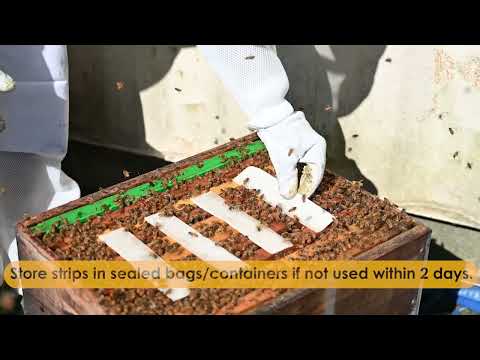
On a normal strength production colony, we recommend adding 4 strips. The strips are placed horizontally over the top bars of the frames in the lower brood box. Scrape off all burr comb that could impede bee movement over the strips.

Suggested layout of 4 cloth strips on top of the frames on the first brood box of a double brood hive
Strip life in the colony.
There are many variables to effective strip life, like how much the bees cover it in propolis and how much they chew it. Based on extensive field experience, the strips should be replaced every 8 to 12 weeks. If re-invasion from other colonies is an issue, (it can be very severe in Autumn), do not go longer than 8 weeks
Winter Use
If your colonies have a brood break in winter, it is better to do an Oxalic Acid vaporization treatment just before they go into a tight cluster, than to use the strips. If there is always brood present, use 1 or 2 Beequip cardboard strips.
Shelf Life
The strips will last many years in their dry form, providing they are kept dry. When soaked, they have a minimum shelf life of 12 months if kept in a fridge in a sealed bag. If stored at 20 – 25°C, the shelf life is approx. 6 months due to the cellulose degradation in the presence of the acid.
Always store out of sunlight and in sealed bags.
Watch the process
Video guides
Watch the videos here, or open them on YouTube.
▶Close video
Hobbyist Mixing Video
Preparing and soaking cloth strips in small batches.
Watch on YouTube ↗