



Capture: The perfect clamp (like tongs with soft rounded edges) to safely scoop up a good number of attendant bees directly from the frame.
Transport: Spacious and well ventilated, the cages can be latched together to form blocks for mailing.
Introduce: Thin enough to slide between the frames. Equipped with two chambers. One for candy and one for a water sponge. There are also two break-out bars.
Slide lock: Locks the cage shut and covers the opening to insert the queen. The opening can also be used to remove unwanted attendent bees before placing the cage into a bee hive.
Manufactured from high quality food grade polypropylene. Weight: 20 grams.
Bees get hungry during winter and Spring Our sugar syrup is the perfect option to give them that much need boost.
Invert sugar syrup is often considered better for feeding bees compared to regular sugar syrup due to its composition and digestibility. Here are a few reasons why invert sugar syrup is preferred:
Easier digestion: Invert sugar syrup is a mixture of glucose and fructose, which are monosaccharides that bees can readily absorb and utilize for energy. In contrast, regular sugar syrup is primarily composed of sucrose, a disaccharide that bees need to break down into glucose and fructose before they can digest it. Invert sugar syrup eliminates this extra step, making it easier for the bees to digest and use the energy immediately.
Nutritional benefits: In addition to glucose and fructose, invert sugar syrup contains trace amounts of other nutrients and minerals that are beneficial for the bees' health. These additional components can provide some nutritional support, especially during periods when natural nectar sources are limited.
Reduced crystallization: Invert sugar syrup has a higher ratio of fructose to glucose compared to regular sugar syrup, which helps prevent crystallization. Crystallization can occur when bees store the sugar syrup in their hive and the water content evaporates, leaving behind crystallized sugar. Invert sugar syrup's lower tendency to crystallize makes it more convenient for the bees to store and consume over time.
Enhanced stimulation: Bees are naturally attracted to the taste of nectar, which contains a mixture of glucose and fructose. Invert sugar syrup closely mimics the composition of nectar, making it more appealing to the bees and stimulating their foraging behavior. This can be particularly useful in situations where beekeepers need to encourage hive activity or provide supplementary food sources.
Invert Sugar Syrup, 67 Brix, 2:1 Heavy Mix
Available in 4 & 20 Litre options
Rechargeable 5W Head Torch - with RED LIGHT!
745-0205
Price excludes GST
Regular price
$24.00
Save $-24.00
Bright Head Torch with micro USB charging port.
2 x Red LEDs for Shifting bees at night as bees don't go for red light!
5W LED White Light
Glow in the dark button!
160 Lumens
Built-in 1200mAh Polymer lithium battery.
Comes with a USB charging cord
Formic Acid 65%
760-0101
Price excludes GST
Regular price
$12.00
Save $-12.00
65% Formic Acid – Ready for Nassenheider Evaporators
Important: Formic Acid can't be shipped to rural addresses. See shipping details at the bottom of this page or contact us to discuss your options. Shipping may take a few extra days.
Temporary Shipping Delay: We are currently experiencing delays of 2 to 3 weeks for delivery. We appreciate your patience while we resolve this.
For Use with Nassenheider Evaporators
This 65% Formic Acid solution is prepared for use with the
Nassenheider Professional Evaporator, enabling slow and consistent evaporation over approximately 20 days. Designed for easy handling and consistent performance in temperature-controlled applications.
Key Features:
Pre-Mixed 65% Solution – No dilution or mixing required
Steady Release Profile – Suited to devices such as the Nassenheider Evaporator
Available in Two Sizes – Choose between 1.15kg bottles or 23kg drums
Compatible with Common Application Devices – Used in both professional and hobbyist settings
Available Sizes:
1.15kg Bottle – Ideal for small-scale applications
23kg Drum – Suitable for bulk or repeated use
Application:
Add the required amount to your Nassenheider Evaporator following the manufacturer’s instructions. Evaporation may occur over a period of approximately 20 days depending on environmental conditions. Always follow all safety and handling guidelines.
Safety Guidelines:
Wear protective gloves and safety goggles when handling
Use in a well-ventilated area away from heat and sunlight
Keep out of reach of children and animals
Store upright in a cool, dry location
Shipping Information
Formic Acid is classified as a Dangerous Good (DG), and special transport conditions apply:
1.15kg Bottles:
Ships via courier to urban addresses only (no rural delivery)
Up to 6 bottles can ship in one parcel for the same DG charge
23kg Drums:
Must be shipped via truck to urban business addresses only
Freight costs are better value for 4+ drums per shipment
Freight Estimation:
After adding items to your cart, proceed to checkout to view the estimated shipping cost. If the rate looks high, return to your cart and submit a quote request for a more accurate freight price.
Need help? Contact us for assistance with bulk shipping or delivery options.
⚠ Disclaimer
This product is not advertised or sold for any agricultural compound use as defined under the ACVM Act 1997, including but not limited to the treatment or control of Varroa mites. If you require a registered product for such use, please consult an appropriate registered compound or seek professional advice.
BQ Swedish Cloth
751-0043
Price excludes GST
Regular price
$0.40
Save $-0.40
Swedish Cloth is used extensively by beekeepers in the USA to keep their beehives healthy.
It is an excellent matrix for absorbing Oxalic Acid / Glycerine solution.
The Beequip Swedish Cloth is a high-quality product made in Germany, consisting of 70% cellulose, 30% cotton, and is 100% biodegradable.
Now available in two options:Standard & Organic*
*Organic Option: If you are operating under an organic certification program, please confirm acceptability with your certifier
Important: Research from clients in the USA states that four strips are more effective than using a single pad with the same surface area. Having 260% more edge line significantly improves efficacy.
Packed 4000 per carton, 80,000 per pallet.
Directions:
Prepare a solution comprising 50% Oxalic Acid Dihydrate and 50% food-grade glycerine by weight. See detailed instructions and videos in the mixing guide. Beequip Cardboard strips are soaked in a solution of 40% Oxalic Acid, whereas Swedish Cloth strips use a 50% solution. Note that a 50% OA/Glycerine solution takes slightly longer to dissolve and mix properly.
While the solution is around 54–58°C, soak each strip with approximately 25 grams of solution. Place the strips on their edges in a flat-bottomed soak bin, ideally in a warm place (20–30°C). Strips absorb the solution fully within 60 minutes. Allow the bin to stay in a warm place for 24 hours to equalise the solution distribution. When cooled to room temperature, the solution will solidify within each strip.
The strips can then be used immediately or packed into airtight ziplock bags for long-term storage.
A typical strong colony with two brood boxes should have four strips placed horizontally between the brood boxes, leaving spaces between the strips.
Scrape off burr comb first.
The four strips work more effectively than using a single larger pad.
Reports from the USA indicate that this system is extremely effective when placed horizontally between the brood boxes in double brood box hives. However, there were questions about efficacy when used over single brood box colonies.
In New Zealand trials during the 2024–25 summer, the cloth strips showed very good efficacy in single brood hives with the following method: -
Laying strips horizontally over the brood box.
Using a rimmed queen excluder to maintain bee space.
Stacking honey supers above.
The beekeepers who did this trial said they were very impressed with the results, and plan to repeat the process next season. They also said that the bees built little burr comb on top of the excluder mesh - an excellent surprise.
Strong colonies maintained strip temperatures above 32°C, keeping the glycerine liquid, and the oxalic acid active. With heavy bee traffic, oxalic acid was effectively spread throughout the brood nest. (We were concerned in NZ that the strips could get cold. No OAE (oxalic acid extended-release) strips work very well if they get below 30°C. They need to be at brood temperature or close to it).
Important Tip for Double Brood Box use
When the soaked strips are placed between two brood boxes, it is very important that all the burr comb is removed so that there is a bee space above the strips. If this is not done, the burr comb can squash a lot of solution out of the strips and prevent the bees from walking on them and transferring the solution around the hive. The strips will be rendered largely ineffective.
A Sustainable Summer Treatment
The evidence is clear: Swedish Cloth strips are a reliable option for summer oxalic acid treatments, provided colonies are strong enough to maintain warmth and distribute the treatment.
Some of the advantages:-
Low cost and very easy to apply
10 – 12 weeks of good efficacy
Does not cover brood on the frames, causing death like most other strips.
All natural product.
Can be used during the honey flow.
The bees will discard most of the strip outside the hive if they are left in place for a long enough period.
Winter Use?
Early results also suggest potential for winter use, though more research is needed. A field trial done from Jan 2025 to late Aug 2025 in the nelson region showed very good results.
Conclusion. If there is a bee space above the strips, and enough bees in the hive to keep them at the right temperature and to give good foot travel on them, then they will work very well anytime.
At Beequip, we’re excited to support beekeepers with innovative, sustainable solutions like Swedish Cloth strips—helping hives thrive, naturally.
Frame Grips
750-0250
Price excludes GST
Regular price
$13.00
Save $-13.00
Frame grip. Zinc plated. Suits wood and plastic frames.
The pivot point is very close to the jaws which ensures a very good tight grip of the frame.
Excellent when working with the Technosetbee trifold frames in the Q8 Queen Mating Nucs.
Screws for Boxes - (Stainless Steel)
801-9250
Price excludes GST
Regular price
$46.00
Save $-46.00
Top quality 304 grade stainless steel.
They have a No.2 square drive head and are the ideal size for timber beehive boxes. 38mm long.
Priced as per packet of 500 screws.
Smaller packets of 125 available. Click on the pack size tab.
One-handed Queen marking tool
750-0434
Price excludes GST
Regular price
$16.00
Save $-16.00
Catch and mark your queens only using one hand!
Simply get the queen in the cavity, slide the shutter over it, then gently slide the foam platform up to the shutter so you can mark her.
Top Quality Original Design - Made in South Korea
Roller Queen cage
750-0433
Price excludes GST
Regular price
$1.00
Save $-1.00
Roller queen cage with one open end.
Can be used to protect and hold queens in the hive when they hatch.
The cap has little cavities to place supplement to feed the queens if necessary.
Three Layer Vent Jacket
701-51FW-XS
Price excludes GST
Regular price
$138.00
Save $-138.00
END OF THE LINE PRODUCT
The ultimate suit on those hot days for the Beekeeper. This special design allows excellent airflow without compromising protection. The three layers of mesh are over 2mm thick and made tough for long life. Designed by a beekeeper at Beequip NZ and incorporates a huge list of features and benefits.
All zipped veils have two zipper heads with handles for easy gripping with gloves.
Veils can be easily unzipped and removed. The Jacket can then be machine washed.
All zips are heavy duty and long life.
No collar to tickle your cheeks and make you hotter and uncomfortable.
The folding veils have sun protector strip above forehead.
Easy to partly unzip the folding veil and flip it on to your back while not required or when driving.
Comes with the folding veil as standard. Alternatively, the round hat type veil can be fitted for a small fee at the time of purchase if desired.
Has 4 pockets with Velcro openings or flaps.
The top left pocket has a pen holder channel.
The elastic waist band fits snugly. It should be tucked into trousers for maximum protection.
Large range of sizes available. XS, S, M, L, XL, 2XL, 3XL, 4XL, 5XL, 6XL, 7XL.
Three Layer Mesh Bee Jacket Size Chart - Adults. (cm)
XS
S
M
L
XL
2XL
3XL
4XL
5XL
6XL
7XL
Waist minimum
81
82
82
86
86
88
90
92
Â
92
94
Waist maximum (Stretched out)
116
118
120
124
128
132
136
136
Â
147
150
Chest
116
118
120
124
128
132
136
136
Â
146
150
Back of neck to end of sleeve
86
89
89
92
96
101
104
106
Â
115
116
Back of neck to hem on waist
69
71
72
76
80
83
86
88
Â
90
91
Anti-Ant Feet - Set of 4
761-0030
Price excludes GST
Regular price
$18.00
Save $-18.00
Got a problem with ants in your Beehive?
Ants love honey and some ants are omnivorous so eat the brood as well! A beehive is a perfect food warehouse for them. Ants don't sleep and can forage 24/7 if the temperature is over 10 degrees celsius. Bees have very little defence against Ants and they can cause far more damage than beekeepers realise.
These stainless steel feet are designed to create a barrier against ants entering your hive. Simply attach them to your beehive base/floor, fill the tray with vegetable oil and the ants are stopped immediately!
The feet feature a rain cover for the tray to stop water getting in. This is important because otherwise water will sink to bottom of tray and the oil spills out the top. Then on a hot day the water evaporates and disappears.
The feet come in sets of 4.
Threaded stud mount This type is designed to be fitted by drilling four 10mm diameter holes of equal depth in your base (40mm) and then inserting the stud. With this method they can be easily added or removed. Drill 9.5mm diameter holes if you want the studs to be a firm fit. Tap the studs into the holes gently with a block of wood, before the tray is fitted. Technoset bases: - Remove the plastic feet from the base and there is a hole already in the base to suit the stud. Add some thin wall tube to the stud if a tight fit is required.
Tip. Ants will walk up grass or weeds to access a beehive. Keep all weeds or grass clear of the hive. Second hand carpet is usually available free in most places and is great weed matting. Mounting the base on a pallet is also very helpful.
InstantVap COMPACT 18 volt
760-0050-Ma
Price excludes GST
Regular price
$870.00
Save $-870.00
2nd Gen InstantVap
InstantVap COMPACT 18 Volt
The latest 2nd Gen version of the popular InstantVap has arrived. The InstantVap COMPACT makes vaporising oxalic acid in beehives simple, fast and practical in the field.
Similar to the previous generation, this unit makes OA treatment an absolute breeze — now in a smaller, lighter and stronger design with simplified LED operation.
Smaller & lighter Easier to handle across multiple hives.
Simple LED control Watch the light to know exactly what the unit is doing.
Field-ready design Strong stainless, acid-resistant frame and dispenser.
Low cost per hive Treat 1000 beehives from approximately $15.00 + GST in materials.
Important: The device is compatible with only one type of battery fitting. Please select your battery style carefully. Price does not include batteries.
Video of the original InstantVap model showing application procedures is also available here. This applies to all InstantVap models.
New compact design
This updated model has had a radical overhaul. It is smaller, lighter and stronger than the previous unit, while focusing on the essentials needed for practical treatment in the field.
The unit sits better with most standard batteries and is controlled by one switch with a clear LED indicator.
LED status guide
The InstantVap COMPACT is preset to the right parameters. Simply watch the LED to understand the current status.
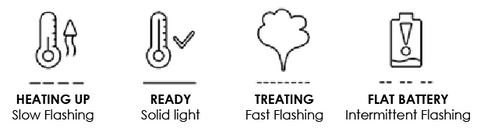
•Slow flashing: Heating up
•Solid light: Ready
•Fast flashing: Treating
•Intermittent flashing: Flat battery
Applications & suggested dose rates
1
Beehives with solid bases
Apply 2g of OA vapour at the bottom entry. Block the entry with a wet towel for 5–7 minutes to trap vapour in the beehive while treating other beehives.
2
Beehives with vented bases
Use a vent blocker sheet and carry out the same process as above. Vent blockers can be removed after 5–7 minutes.
3
Difficult-to-block vented bases
Use a 3g dose from the top of the hive. A small notch in the hive mat, or in the rim of the queen excluder, can provide good access for the vaporiser.
4
Front-plate application
Apply vapour through a hole in the front plate of the brood box. Drill a 6.5mm hole if using the bare brass nozzle, or a 9.5mm hole if using the silicone sleeve. Block the hole with a golf tee after treatment.
Approx. 1Ah for heating up, then 1Ah provides enough power for 9–10 two gram doses.
Dose timing
Each 2g dose takes approximately 18 seconds to vaporise.
Build material
Stainless, acid-resistant steel frame and dispenser.
Operating temperature
Pre-set at 230℃ / 445F. Not adjustable.
Dispenser
Fast, tool-free, roll-on adjustment with 1–4 gram scale.
Nozzle
6mm strong brass outlet pipe, designed to reduce clogging and allow easy cleaning.
Clearance
Minimum 100mm free space in front of the nozzle is recommended.
Weather performance
Double-wall furnace works well in cold, windy weather.
Battery compatibility
The InstantVap COMPACT is powered by common power tool batteries. Select the correct battery fitting before ordering.
Makita LXT 18VMilwaukee M18Bosch Blue / ProCore 18VDewalt XR18/20VMetabo 18VOzito PXC 18VAEG Pro 18VHiKOKI / Hitachi 18V
Battery note: Dewalt Power Stack batteries are incompatible. Batteries are not included.
Practical Beekeeping in New Zealand Book
770-0101
Price excludes GST
Regular price
$52.17
Save $-52.17
Practical Beekeeping in New Zealand – Book
Written by experienced New Zealand beekeepers, this comprehensive guide covers all the essential aspects of hive management in local conditions. With a seasonal management plan tailored to NZ’s climate, it provides month-by-month guidance to help beekeepers succeed. Featuring 285 pages of practical advice and detailed photographs, this book is an invaluable resource for both beginners and experienced apiarists.
Key Features:
Written specifically for New Zealand beekeepers
Seasonal management plan for NZ conditions
285 pages of practical advice and photos
Covers all key aspects of hive management
Essential reference for hobbyist and commercial beekeepers
Extract your own honey with ease using this affordable and reliable 2 Frame Manual Honey Extractor. Designed for hobbyist and small-scale beekeepers, this extractor is the perfect entry-level tool for harvesting honey from your own hives.
Features:
Fits Full Depth and ¾ Depth Frames Compatible with the most commonly used frame sizes in New Zealand beekeeping.
Food Grade Plastic Drum Lightweight, durable, and easy to clean. Made from hygienic food-safe materials for safe honey handling.
Manual Operation No electricity needed. Simple hand-crank design gives you full control over extraction speed and direction.
Compact Design Ideal for home use, easy to move and store. Perfect for seasonal honey extraction without taking up too much space.
Specifications:
Height: 65cm
Diameter: 40cm
Additional handle clearance: approx. 15cm
Assembled footprint: 520mm (W) x 420mm (L) x 680mm (H)
Why Choose This Extractor?
This honey extractor offers excellent value for money and is a great option for new beekeepers or those with a few hives. It’s easy to assemble, operate, and clean – helping you enjoy the rewards of beekeeping with minimal hassle.
Ready to harvest your own honey? Order now and get started with this efficient, cost-effective extractor.
Ensure honey in the frames is warm enough. Straight off the hive is usually okay if the weather is not too cold and the bees have been brushed or blown off the frames. Otherwise, leave in a small warm room at around 28 degrees C for 48 hours.
Clean equipment before use.
Uncap frames as shown in video.
Use frames of similar weight on opposite sides to reduce vibrations.
Run extractor at about half speed to get half the honey out of the first side. If the frames have wax foundation and you go too fast, the weight of the honey on opposite side will damage the comb.
Turn frames around and spin honey from other side. Depending on honey type and temperature, one pass may be enough on second side or it may need to be done with 2 passes. 2ndpass can be faster than the first.
Shift frames back to first side and extract remaining honey with a slightly faster speed.
Let the honey flow out of the extractor through a stainless steel double strainer and into food grade honey pails with honey gates at the bottom.
Leave the honey pail in warm place for 2 days to allow any wax residues and air bubbles to go to the top.
Then you can decant beautiful pure honey out of the honey gate at the bottom into polyjars, or similar.
The wax cappings can be left to drain over a grid like a stainless steel queen excluder. (Leave in a warm place to allow maximum honey to drain from the wax.)
The drained honey can be poured through a honey strainer. (Repeat steps 9 – 11.)
Scientifically formulated and non-toxic. Attractive to wasps, not bees.
A specially formulated, non-toxic liquid lure which is attractive to Common and German wasps, but NOT to bees or Paper wasps. For use in the refillable NoPests® Wasp Dome Traps. Available in 1L & 5L packs.
Tip: Use in summer & Autumn to control active wasp populations and also in Spring to control queen wasps as they come out of hibernation, preventing population growth.
Directions for Use with the Wasp Dome Trap - purchase that here.
Unlock the Wasp Dome Trap, pour in 250ml of NoPests® Wasp Lure.
Lock Wasp Dome Trap lid to closed position.
Locate trap in direct sunlight in areas where wasps frequent, using hanging cord provided.
Inspect the dome trap regularly and remove dead insects.
Replace lure monthly, or when levels drop due to evaporation.
If the dome trap is full and there is no free liquid, remove contents and rinse with clean water before refilling with NoPests® Wasp Lure.
Note:
Avoid spiling the lure or leaving shallow puddles of it anywhere as this can end up crystallizing and losing the efficacy of the bee deterrent.
If using this with the Technoset wasp trap – put the lure in a small container rather than the tray provided so it doesn’t crystallize.
Division Board | Hive Mat with cut entry
790-0011CE
Price excludes GST
Regular price
$14.80
Save $-14.80
Hive mat with a 40mm entry cut into the rim
Also known as a Division Board, Merge Board or Gated Hive Mat
The Wooden rim is Dipped
Nassenheider Evaporator
760-0100
Price excludes GST
Regular price
$28.00
Save $-28.00
Please order in multiples of 2 units. That is how they are packaged at the factory, with 46 evaporators packed per carton. Please note: the evaporator is sold without 65% Formic Acid. Click here for Formic Acid.
Take control of hive health effortlessly with the Nassenheider Professional Evaporator. This long-term evaporation system is designed for safe and effective treatment in beehives. Perfect for autumn (and spring) use, it utilizes a 65% formic acid (FA) solution for consistent evaporation over a 20-day period when using the No.2 wick. Beehives with high pest pressure can be brought into balance in a relatively short space of time. In areas with high re-infestation issues, it is recommended to do 2 treatments. For treatments in summer or during a honey flow, we recommend using Oxalic Acid Extended-release (OAE) strips.
Key Benefits:
Cost-Effective Hive Care – A reliable, long-term solution that reduces expenses.
Healthier Bees – Clients report reduced symptoms of chalkbrood and nosema after a 20-day FA treatment.
Boosted Honey Yields – Stronger colonies mean better honey production.
No Resistance – Nowhere in the world have pests grown resistance to these natural products – Formic Acid, Oxalic Acid or Thymol.
Proven over Many Years – European beekeepers have been using natural products for over 40 years.
No Residues – Formic Acid and Oxalic Acid leave zero residues in the comb.
Less Sugar Feeding – Healthier bees naturally gather more food during the off-season.
Simplified Safety – Easy-to-follow procedures minimize risks when handling formic acid. 65% FA is safer to handle than common off-the-shelf 84% FA.
Product Features:
Complete Kit: Includes the evaporator, 250ml bottle, and three wick sizes for adjustable evaporation rates.
No. 1 Wick: Very slow evaporation and suggested for use in nucleus colonies.
No. 2 Wick: Ideal for single brood box colonies, evaporating 250ml of FA in approximately 18 days. Filling the bottle to the top (≈290ml) lasts around 20 days — about 14ml/day.
No. 3 Wick: Recommended for double brood box colonies. One of our tests in Jan 2025 showed 250ml evaporation in 7 days (≈36ml/day).
Versatile Design: The evaporator requires a 75mm spacer rim located directly above the brood box. 90mm top feeder rims or empty supers can also be used.
With 65% Formic Acid, it is recommended to evaporate between 9 and 22 millilitres per day per full-depth brood box. 22ml per day in one brood box is at a level where it is thought to disrupt pests under the cell cap. However, that high level of exposure is not necessary for good control. 14ml per day will eliminate virtually all phoretic pests (those on adult bees). Drone cells are capped for 14 days, so as long as there is continuous application for at least 15 days, effective control can be achieved.
Safety
Formic Acid liquid, and the gas from the liquid, can damage skin and eye tissue. It is very important that suitable protective clothing is worn. This is especially important when filling bottles from bulk containers. A respirator mask with face protection, nitrile gloves, PVC apron, and overalls should all be worn. Replacing empty bottles with full bottles in the field requires nitrile gloves as a minimum. Stand upwind when performing this procedure.
Field-Tested Results:
In a Featherston field trial, where autumn hive health management was historically challenging, the Nassenheider Evaporator delivered outstanding results, significantly improving colony strength and overall health. Read the full blog HERE.
Usage Tips:
Assemble evaporator parts with the desired wick size.
Spread the fleece cloth in the tray and secure it with the clips provided. Double up the cloth at one end so the post for the bottle clamp is not covered.
Fit the bottle holder onto the post.
In an outdoor location and with suitable protective clothing, fill the bottle with 250ml of FA and secure the lid for safe transportation.
At the apiary site, place the tray on top of the brood nest.
Remove lid from bottle and screw on the evaporator while the bottle is vertical.
Check the screw connection for tightness to ensure safe operation.
Place the bottle with evaporator into the bottle holder. See video for more info.
Fit a 75mm rim to surround the evaporator. Fit hive mat and lid.
For creative beekeepers: Cut old full-depth boxes into three rims and paraffin-dip them for sterilization.
Top Tip: Extra bottles can be purchased separately here. Fill hundreds of bottles safely, then fit them to evaporators in the field as required. The beekeeper is exposed to minimal FA and only needs protective gloves — similar to handling Formic Pro pads.
NB. If your beehive has a vented base, it is recommended to block the vents and leave the front entrance fully open for best results.
Engineered for performance and safety, the Nassenheider Professional Evaporator is trusted by beekeepers to protect their hives effectively. With 46 units per carton, stock up for your apiary or share with fellow beekeepers. Order in multiples of 46 for the best value!
Click Hereto buy a Battery Charger for these batteries.
0.55mm Stainless steel Frame Wire - 1kg Roll
750-0100
Price excludes GST
Regular price
$24.00
Save $-24.00
Stainless steel Frame Wire. 0.55mm diameter. 1kg Roll
Varroa Collection Trays
950-0108
Price excludes GST
Regular price
$13.80
Save $-13.80
Varroa collection trays. White. 270mm x 350mm
Cut Comb Frame - Full Depth
950-0023
Price excludes GST
Regular price
$7.00
Save $-7.00
Technosetbee Full Depth #2 Frame for Comb Honey Production:
This new revolutionary frame is designed for comb honey production. The beekeeper simply cuts a sheet of wax foundation into two pieces as shown in the photos and inserts each piece through an opening in the top of the frame. (One small offcut is not required.) The two squares are 203mm x 195mm each. A plastic capping locks it into place.
The Thin Super wax foundation can be purchased already cut to the correct size here.
When honey is capped, simply slice with an electric knife or a hot knife into the desired sizes.
Each of the 4 rectangles (or windows) in the frame are 184mm high. The 2 outer rectangles are 88mm wide. the 2 inner rectangles are 97mm wide. If the comb is cut to 105mm long to suit the larger square containers, the comb honey will weigh between 300g and 340g, depending on thickness.
Cut-comb honey containers are available here. Cut the honey comb up to suit the container sizes.
Manufactured from high quality food grade polypropylene. End bars are 36mm wide. 10 frames will fit snugly per box. Alternatively you could fit 9 frames per box and space them evenly to produce thicker slabs of comb honey.
Comb Honey is very much sought after and sells for very high prices. These frames make the job so much easier and more efficient.
Frame net weight: 0.35 Kg
Caution! Do not use these frames in areas where the bees could collect poisonous Tutin.
In NZ tutin zones, any honey harvested after 31st Dec must be tutin tested. When the honey is cut from the frames, the honey dribbles from every cut must be collected, blended and a sample sent to an authorised laboratory for tutin testing before the honey is sold or given away.
Tutin can potentially be collected anywhere by the bees above the latitude line of 42 degrees south in NZ. (Where the Passion Vine Hoppers live)
Queen Isolation Cage 240
760-0240
Price excludes GST
Regular price
$6.00
Save $-6.00
For brood breaks and healthy hive management.
Queen Isolation Cage
As varroa mites become resistant to miticides, and varroa re-invasion issues become more severe, beekeepers all over the world are searching for alternative treatments.
Brood breaks in conjunction with Oxalic Acid vaporisation are extremely effective and low cost, and are becoming a very popular option.
Quick summary
Purpose-built cages made from food-grade Polypropylene.
Sliding door on one side.
Side openings in the grill are 4.2mm, the same as a queen excluder.
Nurse bees can go in and out to care for the queen.
Large enough to allow plenty of pheromone distribution, so the bees don’t try to supersede her.
Technical details
Material
Food-grade Polypropylene
Side openings
4.2mm, same as a queen excluder
Outside dimensions
240mm x 29mm x 34mm high
Pack size
Packed 100 per carton
Releasing the queen
To release the queen, slide open a door on the cage and she will come out as soon as the hive is closed back up.
Product video
Fitting into a brood frame
It is recommended to cut a window out of a brood frame and fit the cage into the window. The bees will secure it in place.
The frame can live permanently in the hive. Position it as an outer frame in the brood box when it has no queen enclosed.
When the queen is inside, keep it near the middle of the brood box so she keeps warm and fed.
Using a ¾ depth frame
It is recommended to use a ¾ depth frame in a full depth brood box. The bees will build drone comb underneath it.
If there are any mites in the hive, they will tend to go to these drone cells. When they are all capped, they can be easily scraped from the bottom of the frame and disposed of, mites and all.
Alternative cage position
Some beekeepers fit the cage between 2 frames in a horizontal position instead of vertical. The comb is scraped back to the foundation.
There is a question whether this way allows enough pheromone to be released, but it seems to be okay.
Applications
Varroa control by creating a brood break, then vaporising with Oxalic Acid.
Swarm control.
To maximise a honey crop.
When requeening with cells.
For overwintering.
The InstantVap Vaporizer is very quick and efficient for brood break and Oxalic Acid applications.
1. Varroa control
From mid-Spring to mid-Summer, 75% of the varroa mites in a hive can be breeding inside the capped brood cells and are protected from most varroa treatments.
By creating a brood break, all the varroa mites are exposed and can be killed with 1–3 cents worth of Oxalic Acid by vaporisation.
Procedure
Cage the queen for 18 days.
Release her and wait 6 days.
Then you will have 2 days where there will be no capped brood.
Vaporise the beehive with Oxalic Acid and kill almost every varroa mite inside.
Most commercial queen breeders will mark queens for no extra charge. That makes them very easy to find to allow for quick caging and very low cost varroa control.
2. Swarm control
Cage the queen in Spring to control swarming and varroa mite populations.
There are 3 stages that usually precede swarming:
Build excess amounts of drone brood.
Build queen cell cups.
Add eggs to cell cups to produce new queens.
The procedure is best performed during the first or second stage.
Procedure
Cage the queen for 18 days.
Release her and wait 6 days.
Then you will have 2 days where there will be no capped brood. Vaporise the beehive with Oxalic Acid and kill almost every varroa mite inside.
18 days with no eggs makes the bees forget about swarming for a while.
It is important to time this procedure to maximise field bee numbers at the start of the honey flow.
3. To maximise a honey crop
Some honey flows can be very valuable but occur for an intense and brief period of only 2 or 3 weeks.
To maximise the crop, cage the queen 2 or 3 days before the start of the expected honey flow. This allows for the following:
The queen excluder can be removed.
8 days after caging, there will be no brood to feed.
More bees get involved in field duties to maximise the crop.
Less food and pollen required in the brood nest.
Very few foragers collect pollen. They focus on the honey crop.
No chance of getting brood in the honey supers.
The honey crop can then be removed, queen released, and the hive can be vaporised with Oxalic Acid to kill virtually all the varroa mites in the hive.
4. Requeening with cells
Put the old queen into the cage when adding a queen cell. Check the hive 24 days later to see if there is a new laying queen.
If not, the old queen can be let out to continue laying. If there is a good new queen, the old queen can be removed.
There is likely to be no capped brood, so the hive can be vaporised with Oxalic Acid to kill virtually every varroa mite in the hive.
5. Over winter
Beehives in good condition in Autumn will greatly benefit from a brood break in the winter.
If you have hives in a location where this doesn’t happen, you can do it with an isolation cage.
The bees that hatch out after you cage the queen will live happily until the next batch of brood arrives several months later, after the brood break period.
This is all conditional to the bees being healthy and having enough of them at the time of caging.
The queen can be caged for 3 to 4 months without any detrimental effects to her health or performance.
24 days after caging, there will be no capped brood and the hive can be vaporised with Oxalic Acid.
If done with the correct technique, it will kill virtually every varroa mite in the beehive. There is no capped brood for them to shelter in.
Another treatment one week later is recommended to wipe out any possible varroa mite remnants.
Varroa mites can potentially turn up from stray bees from other colonies, but they cannot breed when there is no brood.
Winter brood break advantages
The temperature in the cluster will drop from 34°C to around 22°C to 28°C. With the lower temperature and no brood, there are significant advantages such as:
A lot less honey required in the winter.
A lot less pollen is required.
The worker bees and the queen live a lot longer because they have very little work to do.
There is less condensation in the beehive.
The timber stays dryer and lasts longer.
Only one box of bees is required over winter.
Easier to keep secure in case of storms or floods.
No varroa strips will be required in the beehive unless you have massive varroa mite re-invasion issues from nearby colonies.
Caging the queens in the first week of April and releasing in the last week of July worked very well on some trial beehives in the Nelson region in 2023.
The queens went crazy and laid a lot of eggs very fast. A month later, there were lots of beautiful big frames of very healthy brood.
When the queens are released, the hive can be vaporised with Oxalic Acid so that if there are any varroa mites present, they are virtually all killed.
Example of a cage in a plastic frame secured with SIKA MS bond.
Related option
Another Queen Isolation Cage option is the
Technoset Queen Cage Frame.
It takes the place of a frame and works on all the same principles listed above.
Wooden Section Package. 4-Section Frame
870-0640
Price excludes GST
Regular price
$145.00
Save $-145.00
Wooden Section Package – 4 Section Frame
Produce beautiful, all-natural comb honey the traditional way with this complete wooden section setup. Perfect for beekeepers who want to create premium, 100% natural comb honey in classic wooden sections — no cutting or processing required.
This ready-to-go package includes everything you need to get started, with pre-assembled components and natural materials that showcase your honey in its purest form.
What’s Included:
1 x Half Depth Super – fully assembled, untreated timber for a natural finish. Click Here to purchase separately.
7 x Four-Section Frames – pre-assembled with plywood separators attached, ready for use. Click Here to purchase separately.
28 x Wooden Sections – supplied flat packed for easy setup. Click Here to purchase separately.
28 x Thin Super Wax Sheets – perfectly sized to suit the wooden sections. Click Here to purchase separately.
Simply assemble your sections using the guide below and place the super on your hive — your bees will do the rest. Once capped, your honeycomb can be presented and sold straight from the wooden section for a rustic, eco-friendly look.
📦 Eco-friendly packaging to fit these wooden sections is available here. 📘 Full instruction guide available here.
Short Gauntlet Bee Gloves
701-80-XS
Price excludes GST
Regular price
$25.00
Save $-25.00
Our own design - requested by many beekeepers!
Protect your hands while caring for your bees with our Short Gauntlet Bee Gloves.
Made from durable cow hide with a reinforced wrist design, these gloves offer maximum protection with minimal wear and tear.
The thick elastic band keeps the bees out, and they are available in sizes XS to 3XL.
This is the basic package that gives you the essentials you need to get started with Beekeeping!
Getting bees can be done in a few different ways – these are the most popular:
Friends – If you have some friends that have bees and would be will to help you out, this is by far your best option.
Bee Club – Your local bee club is usually willing to help you out and support you along the way.
Trade Me – There are usually plenty bees for sale.
The most common way to buy bees is a 5 frame nuc. This consists of 5 frames of bees and a queen.
You put this in the first box with 5 empty frames beside it and then the lid on top. Another box is added as they grow then after that you can start collecting honey!
This package includes: 1 x Hive Tool 1 x Bee Brush 1 x Economy Veil. Size Large 1 x pair of short leather bee gloves 1 x Practical Beekeeping in NZ Book 1 x Smoker 28cm (slightly different to what is shown in the photo) 1 x Beehive Package 25 which includes: - Hive Mat - Emlock Strapper - Galv Roof with Sprung Ends - HiveMaster Wooden Vented Floor - Note different to picture shown. - 10 Frames with Wax Foundation fitted - Untreated full depth Russian Pine Brood Box
*The box will need painting as it is untreated.
Please comment in the Special Instructions box on the cart page as to what size gloves you would like. See stock availability here
Jero Hive Tool - Kelly Type
750-0207
Price excludes GST
Regular price
$25.00
Save $-25.00
One of the Best Quality Hive tools available.
Made in Europe from Tempered High Carbon steel.
This means that under very high load it will simply flex not bend or snap like the common hive tool.